
A few weeks ago, a client walked into my office with something I did not expect. He was not carrying a rough sketch or a list of ideas scribbled on paper. He came with a full brief prepared almost entirely by artificial intelligence.
The document had a proposed layout plan. It had 3D visuals. It had sections through the design. It even had a detailed financial projection and an execution plan for the whole project. All he needed from me, a trained professional, was a small amount of input to refine and validate what the AI had already produced.
I sat there looking at his laptop screen, and I will be honest with you, it made me think hard about where our industry is headed.
For a long time, many of us in construction believed that our work was too technical, too hands-on, and too dependent on experience to be touched by machines. That belief is no longer safe to hold.
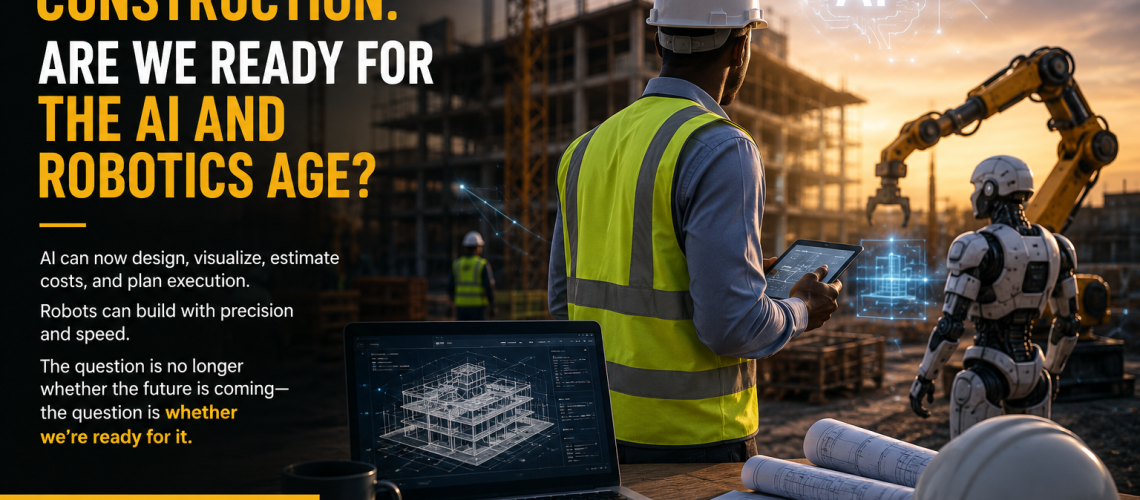
Technology in construction is evolving fast, and the way we draft, design, plan, and even price projects is taking a different turn. AI tools can now generate layouts, produce realistic visuals, run cost estimates, and map out execution timelines in minutes. Work that used to take a professional days or weeks can now be roughed out by a client sitting at home with the right software.
This is not a distant future. It is already knocking on our office doors.
Now take that thought a little further. Imagine a construction site where robotic technology has fully found its way into daily work, and where those robots are guided by AI systems trained with accurate project information.
In that world, detailing becomes sharper. Precision improves because machines do not get tired or distracted. Project delivery timelines shrink because work that depended on manual speed can now run faster and around the clock. Errors that come from human fatigue or miscalculation reduce significantly.
This is not science fiction. It is the direction the built environment is moving toward, one innovation at a time.
This is the question that stayed with me long after that client left my office. If AI can draft, visualize, project costs, and plan execution, and if robots can build with more precision and speed than before, what exactly is left for us?
The honest answer is this: what remains for us is everything that cannot be automated. Judgment built from years of experience. Understanding of context, culture, and client needs. The ability to make sense of a site’s unique challenges. Creative problem-solving when things do not go according to plan. Ethical responsibility for the safety and wellbeing of the people who will use what we build. Leadership on complex projects with many moving parts. These are things a machine can support, but not fully replace.
The future will not belong to those who resist this change. It will belong to those who learn how to work alongside it.
The future of construction calls for a proactive mentality and a continued learning mindset. Standing still is no longer an option for anyone who wants to stay relevant in this industry. Here is what I believe we need to be doing, starting today.
We need to get familiar with AI design and drafting tools instead of avoiding them. Understanding how they work, and where they fall short, puts us in a position to add real value on top of what they produce.
We need to sharpen the skills that machines cannot easily copy. Site judgment, client relationships, negotiation, leadership, and creative design thinking will only grow in value as routine tasks become automated.
We need to invest in continuous learning. Short courses, certifications, webinars, and industry conversations on emerging technology should become a regular part of our professional life, not an occasional afterthought.
We need to position ourselves as interpreters and quality controllers of AI output, not competitors to it. Clients will still need someone to confirm that a design is structurally sound, code compliant, buildable, and safe. That someone should be us.
We need to build a mindset of curiosity rather than fear. Every major shift in this industry, from hand drawings to CAD, from CAD to BIM, has replaced a set of tasks while creating new opportunities for those willing to adapt.
That meeting with my client was, in many ways, a gift. It showed me clearly that the ground beneath our profession is shifting, and it gave me the push to start preparing rather than waiting to be caught off guard.
The tools will keep getting smarter. The robots will keep getting more capable. The real question is not whether AI and robotics will change construction, because that is already happening. The real question is whether we, as professionals, will grow alongside this change or get left behind by it.
I choose to grow. I hope you will choose the same.
What are you doing today to remain relevant in this industry tomorrow?
BY MOSES MWAURA
CONSTRUCTION MANAGER.