
The foundation is one of the most important parts of any building. It supports the entire structure and transfers its weight safely into the ground. When a foundation is poorly designed, improperly constructed, or affected by changing soil conditions, it can lead to serious structural problems.
Foundation failure is one of the most common causes of structural damage in buildings. In severe cases, it can compromise the stability and safety of the entire structure. Fortunately, many foundation related problems can be prevented through proper planning, professional design, quality construction, and regular maintenance.
What Is Foundation Failure?
Foundation failure occurs when a building’s foundation can no longer safely support or transfer the loads imposed on it. This may happen because the soil beneath the building cannot adequately support the structure, the foundation was incorrectly designed or constructed, or environmental factors have changed the conditions around the foundation.
Foundation problems do not always result in sudden collapse. They often develop gradually, with warning signs appearing throughout the building.
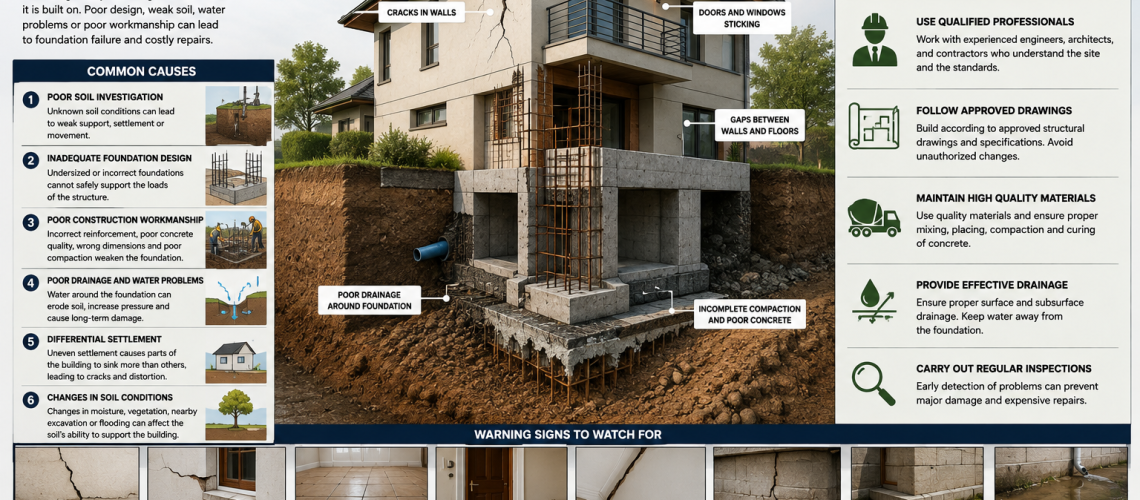
Common Causes of Foundation Failure
1. Poor Soil Investigation
The ground beneath a building plays a major role in determining the type and size of foundation required. Different soils have different capacities to support structures.
Weak, expansive, loose, or poorly compacted soils can settle or move under a building’s weight. Constructing without understanding the site’s soil conditions can therefore increase the risk of foundation movement.
How to prevent it:
A proper site and soil investigation should be carried out before construction. The findings should guide the structural engineer in selecting an appropriate foundation system.
2. Inadequate Foundation Design
A foundation must be designed according to the building’s size, weight, expected loads, soil conditions, groundwater conditions, and other site factors.
An undersized or incorrectly designed foundation may experience excessive settlement or structural distress.
How to prevent it:
Foundation designs should be prepared by qualified structural and geotechnical professionals and should comply with applicable building regulations and engineering standards.
3. Poor Construction Workmanship
Even a good foundation design can fail if it is not constructed correctly. Common problems include incorrect reinforcement placement, inadequate excavation, poor concrete quality, insufficient compaction, and failure to follow approved drawings.
How to prevent it:
Construction should be supervised by competent professionals, with inspections conducted at critical stages. Reinforcement, dimensions, excavation depth, concrete quality, and other important details should be checked before work proceeds.
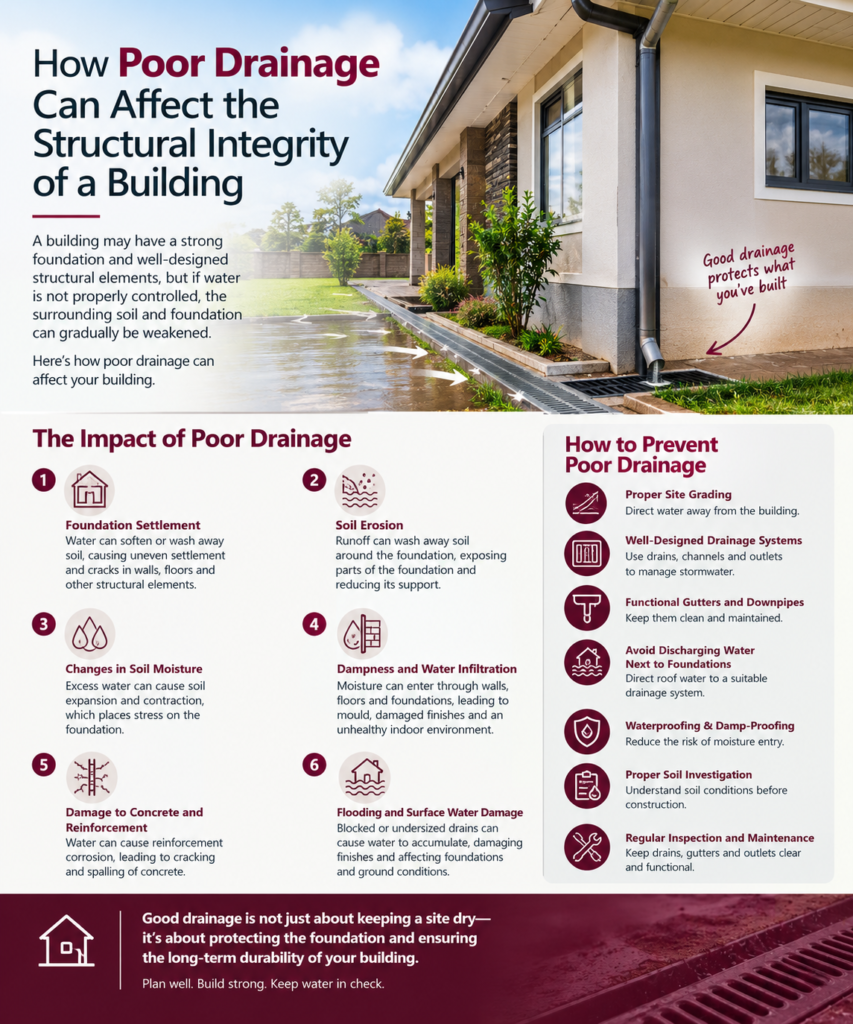
4. Poor Drainage and Water Problems
Water can have a significant effect on foundation performance. Poor drainage may cause soil erosion, excessive moisture, changes in soil strength, or increased pressure around foundation walls.
Leaking pipes and inadequate surface drainage can also cause long-term problems.
How to prevent it:
Provide proper surface and subsurface drainage where required. Gutters, downpipes, drainage channels, and plumbing systems should direct water away from the foundation. Leaks should be repaired as soon as they are discovered.
5. Differential Settlement
Settlement occurs when the ground beneath a building compresses under its weight. Some settlement can occur naturally after construction, but differential settlement when different parts of a building settle by different amounts can cause significant damage.
It may result in cracks in walls, uneven floors, distorted doors and windows, and structural distress.
How to prevent it:
Proper soil investigation and foundation design are essential. The building should be designed to distribute loads appropriately, while weak or poorly compacted soil may require suitable ground improvement or a different foundation solution.
6. Changes in Soil Conditions
Soil conditions can change over time due to changes in moisture levels, nearby excavation, vegetation, flooding, erosion, or construction activities.
These changes can affect the ability of the ground to support a building.
How to prevent it:
Consider the long-term behavior of the site during design. Proper drainage and site management should be maintained throughout the building’s life.
Warning Signs of Foundation Failure
Foundation problems can often be identified before they become severe. Property owners and building managers should watch for:
- Large or progressively widening cracks in walls
- Cracks around doors and windows
- Uneven or sloping floors
- Doors and windows that suddenly become difficult to open or close
- Gaps between walls and ceilings or floors
- Cracks in foundation walls
- Parts of the building appearing to sink or tilt
- Persistent water accumulation around the foundation
Small cracks do not necessarily mean that a foundation has failed. However, cracks that are large, increasing in size, or accompanied by movement should be professionally assessed.
How to Prevent Foundation Failure
Preventing foundation failure starts before construction begins. Several important measures can significantly reduce the risk.
Conduct Proper Site Investigations
Understanding the soil and groundwater conditions is essential. A professional site investigation can identify potential challenges and help determine the most appropriate foundation solution.
Use Qualified Professionals
Architects, structural engineers, geotechnical professionals, contractors, and other specialists all have important roles to play. Working with qualified professionals helps ensure that the building is designed and constructed according to appropriate standards.
Follow Approved Structural Drawings
Construction teams should follow approved drawings and specifications. Changes to foundation dimensions, reinforcement, materials, or construction methods should not be made without professional approval.
Maintain High Quality Materials
Concrete, reinforcement steel, aggregates, and other construction materials should meet the specified quality requirements. Proper mixing, placement, compaction, and curing are also essential.
Provide Effective Drainage
Water should be properly controlled around the building. Good drainage helps prevent soil erosion, excessive moisture, and other water-related foundation problems.
Carry Out Regular Inspections
Foundation problems can become more expensive to repair when they are left untreated. Regular inspections can help identify early warning signs and allow corrective action to be taken before damage becomes extensive.
Why Professional Construction Matters
Foundation construction is not an area where shortcuts should be taken. The foundation carries the loads of everything built above it, meaning mistakes at this stage can affect the entire structure.
A professional construction team understands the importance of proper site preparation, accurate setting out, reinforcement, concrete quality, drainage, and adherence to engineering specifications. These factors work together to create a stable foundation and a safer, more durable building.
Conclusion
Foundation failure is a serious structural problem, but many foundation failures can be prevented through proper planning and construction. Soil investigation, professional foundation design, quality materials, skilled workmanship, proper drainage, effective supervision, and regular maintenance are all essential to long-term structural stability.
A strong building begins with a strong foundation. By investing in quality from the earliest stages of a construction project, property owners can reduce the risk of costly structural damage and ensure that their buildings remain safe, stable, and durable for years to come.
When it comes to construction, the foundation is not the place to cut corners,it is the place where quality begins.