
Construction projects rarely proceed exactly as planned. As work progresses, it’s common for clients to think of improvements, perhaps enlarging a room, relocating a doorway, or moving a wall to create a more open layout. While these changes may appear simple, they often trigger a chain reaction that affects multiple aspects of the project.
These modifications, known as change orders or variations, are one of the leading causes of budget overruns and project delays. Understanding their true impact can help clients make informed decisions and appreciate the value of professional cost management.
A Common Scenario
Imagine a homeowner building a four-bedroom house. Construction is progressing well, and the masonry work is almost complete. During a site visit, the client decides they would like a larger living room.
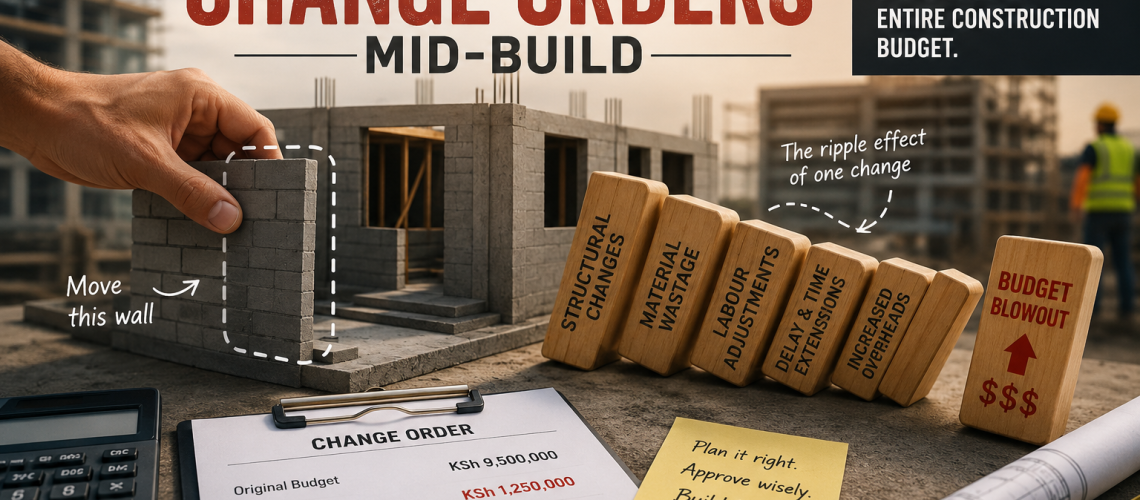
The solution seems straightforward: move the wall separating the living room from the adjacent guest bedroom by one meter.
To the client, it appears to be a small adjustment.
From a construction perspective, however, that single decision affects much more than just one wall.
The Ripple Effect Begins
Relocating a wall after construction has started doesn’t simply involve demolishing and rebuilding masonry. It sets off a series of changes across several building disciplines.
Structural Changes
If the wall supports beams, lintels, or roof elements, structural drawings may require revision. Additional reinforcement, redesigned beams, or altered foundations could become necessary depending on the building’s structural system.
Architectural Adjustments
Moving one wall changes room dimensions, circulation spaces, window positions, door locations, and internal layouts. Updated architectural drawings must be prepared before construction continues.
Mechanical and Electrical Services
Electrical conduits, lighting layouts, switches, sockets, plumbing lines, and HVAC installations may all require relocation. Work that has already been completed often needs to be removed and installed again.
Finishes
Floor tiles, ceilings, plasterwork, paint finishes, skirting, and cornices may need replacement or extension. Even matching existing finishes can become difficult if materials have already been purchased from different production batches.
The Hidden Financial Costs
Many clients assume they are paying only for the additional wall. In reality, they are often paying for:
- Demolition of completed work
- Removal and disposal of materials
- Additional labour
- New construction materials
- Revised professional drawings
- Additional supervision
- Extended project duration
- Potential price increases on materials due to delays
What initially appears to be a minor modification can easily increase project costs by hundreds of thousands of shillings, depending on the stage of construction.
Delays Can Cost More Than Materials
Every change order has the potential to disrupt the construction programme.
While one trade waits for revised drawings, another may be unable to proceed. Suppliers may need to amend orders, and subcontractors may have to reschedule their work.
For developers, delayed completion can also mean postponed rental income or occupancy, adding another layer of financial impact beyond direct construction costs.
Where the Quantity Surveyor Adds Value
This is where the Quantity Surveyor plays a critical role.
Before any change is approved, the Quantity Surveyor evaluates its financial implications by assessing:
- The cost of demolition and reconstruction
- Additional material requirements
- Labour costs
- Professional fees
- Programme implications
- Overall effect on the project budget
Rather than allowing costs to accumulate unnoticed, the Quantity Surveyor provides clear cost advice before work proceeds.
This enables the client to answer an important question:
Is the proposed change worth its true cost?
Sometimes the answer is yes. Other times, clients choose an alternative solution that achieves a similar outcome at a significantly lower cost.
Preventing Budget Blowouts Through Early Decision-Making
The most effective way to avoid costly change orders is to invest sufficient time during the design stage.
Reviewing layouts carefully, considering future needs, and involving all consultants before construction begins greatly reduces the likelihood of expensive mid-project modifications.
A thorough design review may take a few extra days, but it can save weeks of delays and substantial unplanned expenditure during construction.
Final Thoughts
Construction is a carefully coordinated process where every element is connected. A seemingly minor change can have far-reaching technical and financial consequences that are not immediately visible.
Change orders are sometimes unavoidable, but they should never be made without understanding their full impact.
By engaging a Quantity Surveyor to assess proposed variations before they are implemented, clients gain the information they need to make confident decisions, maintain control of their budget, and keep their project on track.
In construction, the true cost of a change is rarely measured by the work you can see, it is measured by everything that change sets in motion.