
In professional practice, one of the most common crossroads property owners face is this:
Should the existing property be renovated, or is it better to build a new?
From a Quantity Surveyor’s perspective within a consultancy environment, this decision is less about preference and more about understanding the nature of each path.
Both renovation and new construction present valuable opportunities.
What differs is the framework within which each must be approached.
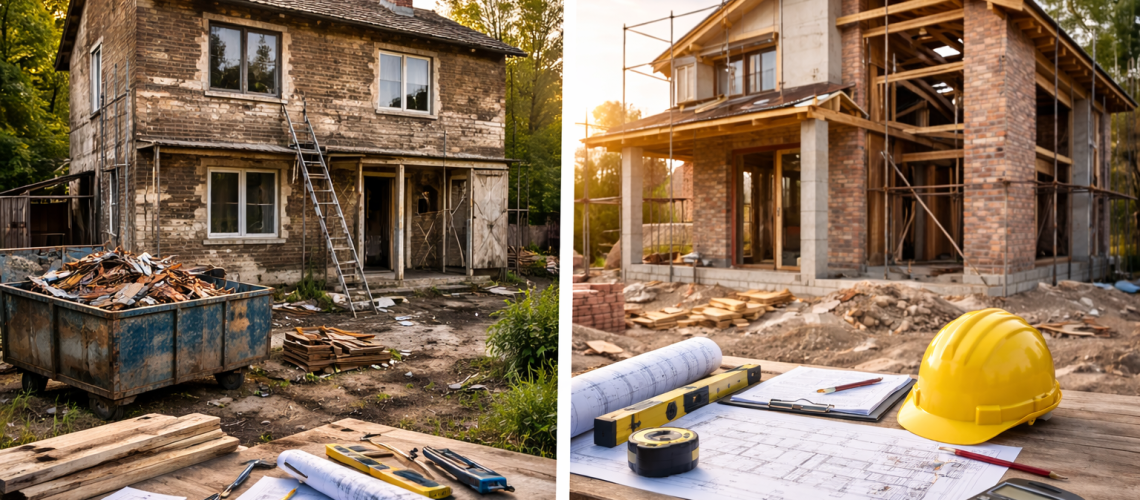
Building New: Structure, Clarity and Full Control
New construction begins with a blank canvas.
From a project and cost management standpoint, this offers a high degree of clarity. Soil investigations, structural systems, spatial planning, and service coordination are defined before execution begins.
The entire development is intentional.
Measurements are clear.
Design integration is structured.
Risks are largely identifiable from the outset.
This environment allows for systematic planning and controlled implementation, which is why new builds often feel more predictable in execution.
Renovation: Unlocking Existing Potential
Renovation operates differently.
Rather than creating from zero, it works with what already exists: foundations, walls, service routes, and sometimes undocumented structural decisions.
In many cases, older buildings carry significant potential. They may occupy prime locations, hold sentimental value, or provide a strong structural base for modernization.
However, renovation requires careful evaluation.
Existing conditions must be understood.
Structural capacity must be verified.
Services must be assessed.
The process becomes investigative before it becomes transformative.
This is not a disadvantage, it is simply a different professional approach.
The Difference Lies in Planning Philosophy
In practice, the distinction between renovating and building new is largely philosophical.
New construction is proactive planning.
Renovation is responsive planning.
With new builds, decisions shape the structure.
With renovations, the structure influences the decisions.
Both require coordination between design, cost control, and execution. The key difference is the level of certainty available at the beginning of the project.
Risk Visibility and Project Control
From a quantity surveying standpoint, risk visibility plays a central role.
In new construction, risks are often technical and measurable, such as soil conditions, material price fluctuations, and program coordination.
In renovation projects, risks may be concealed within the existing building fabric, hidden defects, outdated services, or structural limitations that only become apparent during intervention.
Recognizing these dynamics early is critical to realistic budgeting and programming.
Strategic Alignment Matters
The more significant question is not which option is “better.”
Rather, it is whether the chosen path aligns with:
- The long-term purpose of the property
- The flexibility required in design
- The level of adaptability expected
- The intended lifespan of the development
A renovation may preserve value and enhance functionality.
A new build may offer complete design freedom and structural control.
Both can deliver excellent outcomes when approached with proper planning and professional coordination.
Final Reflection
From experience within professional practice, successful projects, whether renovation or new construction, share one common factor:
Clarity before commitment.
Understanding the structural realities, planning implications, and risk profile of each path allows property owners to move forward with confidence.
Renovating and building new are not competing options.
They are distinct strategies.
And when approached with proper technical evaluation and cost planning discipline, both can achieve lasting and meaningful results.